Friday, April 26, 2013

Professional Development


The Commodore Uriah P. Levy Chapel at the US Naval Academy is gorgeous.

A few fun facts about Commodore Levy, z”l, learned while at the Navy Academy this past week: in addition to saving Monticello and banning flogging, Uriah Levy is known for having been court-martialed six times.

One more fun fact: Uriah Levy once told the King of Brazil, “I would rather serve as a cabin boy in the United States Navy than hold the rank of Admiral in any other service in the world.”  This quote rings especially true having spent my week with US Army and US Air Force Chaplains.

Each year, the Jewish Chaplain’s Council of the Jewish Welfare Board hosts a conference.  Every other year, the program meets at the Jewish Community Centers of America Biennial (the version of Biennial that means “every other year” as opposed to “twice a year”).  Last year, the chaplains hitched on to the JCCA Conference in New Orleans.  In the off-years, the rabbis get together on their own.  This year, we went to Annapolis, MD: home of the United States Naval Academy.

For four days, the rabbis from the Navy/USMC, Army, and Air Force get together.  Reservist, National Guard and Active Duty.  Orthodox, Reform, and Conservative.  We sprinkle in the Veterans Affairs Chaplains for good measure and some decent kvetching (not that the other organizations don’t have their fair share of kvetchers).

We heard presentations by the Vice Chief of Naval Operations, an Under-Secretary of the Army, the Chiefs-of-Chaplains of each of the Armed Services, and by our peers.  There were speeches a plenty.

But the moments that mattered came in three forms:

1) My family came to town, and we got to go to a game at Camden Yards.  I think the O’s could have tried harder to win, but Jake Arrietta is just not a very good pitcher.

2) I spent some quality time with my good friend and former roommate Rabbi Joshua Sherwin: the single, available chaplain at the Naval Academy.  http://washingtonjewishweek.com/m/Articles.aspx?ArticleID=18712. Please contact me if you are looking for his digits.

3) I got to spend time blowing off steam, telling stories, and having beers with some outstanding Navy chaplains (there are a couple ok ones in the Army, but your best bet is in the Navy). 

As a rabbi and as a chaplain, I often find the social element lacking.  Many of my colleagues in smaller communities know this loneliness well.  The convention and some of the personalities might drive me nuts, and there really should be a time limit on how long people in certain military uniforms should be allowed to talk.  

BUT the special moments keep my spirit alive for another year.  I am incredibly appreciative of the JWB for flying me back to the states for the week, and I can't wait to see my favorite chaplains in sunny San Diego next year.

Friday, April 19, 2013

follow-up

A few weeks ago, Yoni wrote a blog post about his battalion’s St. Patrick’s Day Field Meet, and promised pictures to come. Well -- that day is here! I'm glad I had the foresight to bring my big zoom lens that day (also affectionately referred to as my paparazzo lens); there was a lot of funny stuff to see, and most of it was way across the field. I wasn't there the whole day, but I did catch the end; I hope these pictures will help you get a better sense of the hilarity of entire event. 

I'm also including a few pictures of Yoni's FMF pinning, which took place immediately following the Field Meet. What a good day! 

For the first event in the relay race, teams had to carry huge hoses across the field and then back.
Next, one member from each team had to hammer about 20 (pre-inserted) nails into a wooden frame.
This kind of speaks for itself; they had to flip that tire all the way across the the huge field.
It's a bit hard to tell, but there are actually two things happening in this picture. The Marine with the sledgehammer over his head is breaking apart a block of concrete to find the nails that were hidden inside. The Marine lying on the stretcher is waiting to be carried across the field - the final event in the relay. 
Each competing battalion had to design a chariot to be hand-pulled around the track. This is the chariot that Yoni's Marines designed; his Commanding Officer is the one catching a ride. 
Almost to the finish line.
At the end of the Field Meet, Yoni was surprised to be asked to offer a few words of prayer. 
Yoni's C.O. pins on his FMF (Fleet Marine Force) pin.
Not sure what they were laughing about, but it was a nice moment of levity in an otherwise serious ceremony. 
Hooray! 
Proud (and slightly sunburned) wife.

Friday, April 12, 2013

For You Were Strangers In A Strange Land

I had an interesting conversation today with a Jewish woman who is new-ish to Okinawa.  We were talking about what brought us out here, the weirdness that is a first-tour in the Navy, and the experience of being Jewish.

Her husband and I had similar experiences in getting orders to the one place that we did not have on our desired-locations-list.  Neither he nor I were really asked where we wanted to go. 

She was born in Israel and spent her early years there, but she spent the majority of her life in Chicago.  As she put it, “I never really knew what living without Jews around would be like; they were just always there.”  It felt like a conversation that I had with Leora a year and a half ago.

But she told me she couldn’t put her finger on what was missing from her new life in Okinawa -- until she came to services on Friday night.

Was it the liturgy?  No, not so much.
Was it the tunes?  She knows some different tunes.
What was it?

“One of the men introduced himself and started telling me about all his ailments.”  Jewish community at its finest.

I can’t say that the Jewish Community of Okinawa is the strongest Jewish Community in the world (though we are heavily armed).  Nor can I say that we have the best regular attendance, most ruach (spirit), or greatest voices (the Lord did not bequeath tone to the Jewish people of Okinawa on His Sabbath Day).  But between the ailments and the simchas (another Simchat Bat this week!), we’ve got all the makings of a real Jewish community.

Friday, April 5, 2013

The Okinawan Mikvah


There was a major article in the Chabad world about the brand new Mikvah that opened this year in Tokyo.  Rumor had it that the Mikvah at the Jewish Community Center (Conservative) in Tokyo had mysteriously been broken, but that is no longer the case.  After a year hiatus, it is back in service.  

There was a rumor that there is a Mikvah in Okinawa, but I’ve investigated that to where I do not believe that has ever been the case. 

Rabbinic Note:  A Mikvah is a physical bathhouse used for ritual immersion.  The requirement being that the water has to be “mayim chayim”, or “living water”.  Rivers, natural springs, and rainwater make up the base water for most Mikvaot.  There is a Responsa out there that one can turn a pool into a Mikvah by adding some ice; as the ice transforms, it is considered “mayim chayim”, and thus a Mikvah.  It is possible that a Mikvah of this style existed in Okinawa before my time.  However, the only area set aside for ritual immersion is the Baptistery in the Kinser Chapel.  A Mikvah it is not.

That said, I live on a tiny island in the middle of the West Pacific Sea Currents; we have a Mikvah.  The coral reefs make it a little complicated to use, but it does the trick.

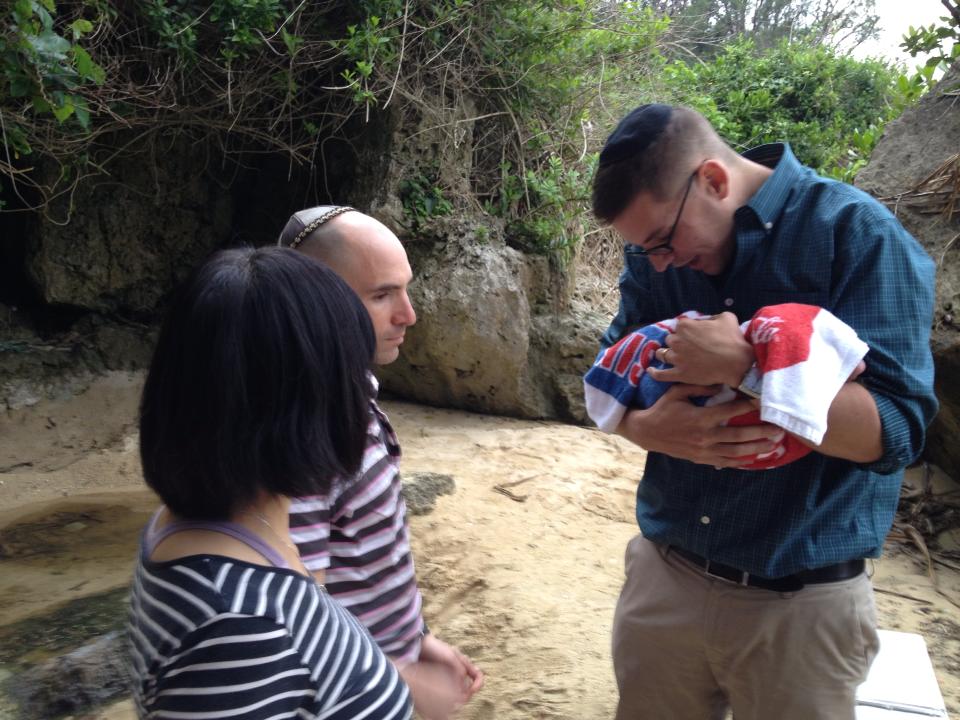
I tell you this not to give you laws of mikvah, but to share a story from my week.  Having returned mid-week from Yokota Air Base in Tokyo, I was asked (prior to my expected flight out to Guam) to make a baby girl (whose father is Jewish and whose mother is in process of converting) into a Jewish baby girl.

I love simchas and I was more than delighted to put together a little ceremony for them (we are also going to have a simchat bat in synagogue in a few weeks).  Originally, I was going to have us all wade into the East China Sea – as we did for the  adult conversions this past Spring.  But then, Betty Hoffman had a brilliant suggestion.

Just below her house (which is on a beautiful cliff and the beach that we were going to use) is a natural spring.  At one point considered a sacred spring (like most springs in Okinawa), it is set into the cliffs and surrounded by a series of caves.  The water in the spring is beautiful, clear and fresh; it pools at about one foot of depth and then flows down into the ocean 10 yards away.  “Can we use the spring?”  Not only can we use the spring, but it is an ideal Mikvah.  While not quite big enough for an adult, we immersed Chloe Ayumi Beyer (Esther Chanah bat Avraham) in the Ancient Okinawan Mikvah.  
The walk down to the Mikvah.  The New Abba is carrying the New Baby.
The New Grandma is walking the Grand-Puppy.

We gave her some wine - because everybody is entitled to some wine at Jewish rituals.
I sang HaMalakh HaGoel as I explained to Chloe how luck of a girl she was and all that she was about to experience.
There is no reason for me to be the only one getting wet.  Bath time is fun for rabbis, abbas and babies.
We rolled up our pants as we walked into the Spring.


"And now you have a whole new Jewish name!  Esther Hannah - a pretty good name for a girl born on Purim".  Esther's Abba, Ema and Rabbi give her a blessing.


Saturday, March 30, 2013

lessons learned

When I made the decision to go to Barnard, there was an internal proviso that went along with it: I would work at getting out of my “Jewish bubble”, not only hanging out with Jewish people or being involved in Hillel-related groups. Those of you who know me well know that my life until that point had been almost entirely contained within the (very large) New York area sphere of Jewish influence. Barnard, with its large population of frum New York girls (women!), might not seem an obvious location to start such a journey, but there it was.

And, largely, I was successful. While I didn’t run away from being Jewishly involved, I did “think outside the box” when it came to building relationships. During my first year, eating in the Hewitt dining hall, I got my first taste of many many conversations to come where I would try to explain Judaism to people who had never spoken to Jews before. It was what I am fond of calling a broadening experience, to say the least. What I didn’t realize at the time was that I needed broadening not only outside the Jewish community, but also within it. 

When I met Elissa, I was, like so many other good Jewish kids from North America, studying abroad at the Hebrew University of Jerusalem. (Ok, so that wasn’t such a bold choice – but I had always wanted to spend a semester in Jerusalem.) As we got to know each other, having long talks on the lawns at Hebrew U or in her dorm room, a number of things became clear to me. First, Elissa was special – there were no two ways about it. She was smart and kind and incisive and funny. Second, it was clear that Elissa knew where she was going in life. Third, and finally, Elissa modeled a kind of Judaism I had never encountered before - she was a Reform Jew who was committed to her faith.

I’m sure this is a terrible thing to say out loud, but, until I encountered Elissa, I didn’t really know that there were committed Reform Jews. Ok, maybe I understood they existed in an intellectual way, but I had never seen any real-life evidence. In my mind, people became Reform Jews when they wanted to maintain some sort of Jewish identity but were no longer interested in regularly attending services or feeling beholden to Jewish law. Let’s just say Elissa showed me the error of my ways on that one. She described to me an entire subculture of Reform kids who sounded identical to the Conservative kids I grew up with – they went to camp, belonged to youth groups, got together for Shabbat. They believed in Judaism, were committed to Israel and social justice, and some of them grew up to be rabbis – as Elissa very much wanted to. As elemental as it might seem, Elissa helped me understand that mine was not the only valid form of Judaism to practice, nor were my methods of celebration and observance the only real or meaningful ones. 

These lessons have been especially important to me in my life here in Okinawa. Yoni is the only rabbi on our tiny island (in the entire WestPac region, really), so Jews who are looking for connection and religion and counsel come to him. It has been something of a struggle for both of us to adapt our practices to meet the needs this community, and I think it always will be. But whenever we get it right, I think of Elissa, how she inspired me with her passion, and how she taught me to accept everyone’s opinions and feelings about Judaism as valid. More specifically: thanks to her, I was really able to enjoy our community Seder this past week. Sure – it was short, and crazy, and maybe not like any Seder I had ever been to before (although that’s not really a fair metric) – but it created a point of religious and social connection and provided the all-important Passover nostalgia factor. 85 people, Jews and non-Jews alike, got together to celebrate the redemption of the Jewish people from slavery in Egypt. So we didn’t use a lot of Hebrew, or sing all the songs I grew up singing – who cares?! We took a different path, but we arrived at the same place: positive religious feeling. Whether she knew it or not, Elissa helped me get to a place where I could happily embrace this feeling of “different as ok.”

Unfortunately, thinking of Elissa during our Seder was bittersweet. Last week, just before the beginning of Passover, Elissa’s family and friends lost her to a six-and-a-half year battle with Nodular Sclerosing Hodgkin’s Lymphoma. She was 29. She never made it to Rabbinical School (though she had been accepted to HUC), but she certainly spent her life inspiring others with her passion for social justice and Democratic politics, her commitment to Judaism, and her love for her friends. I know that I was lucky to have been a part of her life, and I can say, without a shadow of a doubt, that her memory will be for a blessing.

Friday, March 22, 2013

On Friday, the Rabbi Invoked St. Patrick

Military Engineers Love St. Patrick’s Day.

They make up some excuse about St. Patrick building churches that were fortresses for those who were being persecuted.  Nobody is buying it. 

Real reason: Many of the early 20th century’s military engineers were Irish.  And many military engineers like to drink.  And thus we celebrate.

As the Commanding General for the Marine Logistics Group is a combat engineer, there was an uproarious gathering of officers on Saturday night to celebrate the weekend.  To say that there were more than a few men wearing kilts would be an understatement; but what really surprised me were the number of shillelaghs present at this gathering. (see: http://en.wikipedia.org/wiki/Shillelagh_(club))

But what really makes the combat engineer celebration of St. Patrick is the “Field Meet”.  Last week, combat engineers from 9th ESB (my Marines), the Marine Wing Support Squadron (Marines), the Combat Assault Battalion (Marines), the Seabees (Navy), the Red Horse Squadron (Air Force), and the Combat Engineer Battalion (Air Force) met on the field of battle to figure out who was the best.

While we were able to avoid actual combat, the games seemed to be a hybrid of the Highland games (or whatever the Irish equivalent is), Redneck Olympics, Jewish Camp Yom Sports and military weirdness.

There was, of course, tug-of-war and a classic relay race.

There was also a 4x400 relay – but where the racers had to wear full MOP gear (nuclear, biological, chemical weapons protective clothing) and gas masks.

We had an Iron-Man relay: as a 5 member team, each group did 200 pull-ups, 300 pushups, 300 sit-ups, and then a half mile run carrying 20 gallons of water.  Only a few (cough, cough Air Force cough, cough) servicemembers threw up as a result.

I was in the 15-person 7-ton pull (think a tractor pull, but with a massive military truck).

There were feats of engineering and softball matches, with the whole day culminating in a chariot race (what else?); each battalion/squadron designed a chariot and pulled their senior officer with a team of six personnel.

I can tell you that the invocation was powerful and motivational.  The morale was high; but 9th ESB got cheated.  Pictures will hopefully be posted later. And while this week has been crazy with Passover Prep – I look to days like the Field Meet and I know: It’s really nice to have a job like this.

Friday, March 15, 2013

jumbo sunshine


Imagine the loudest room you’ve ever been in - - then triple it. That is what the inside of Jumbo Sunshine (a Pachinko parlor) sounds like.


For those of you who have not spent copious amounts of time in Okinawa, Pachinko is a gambling-style game involving machines. Even though I spent about 40 minutes “playing” with Yoni and Margot this past week, that’s still about as much as I understand. Suffice it to say that it’s a form of gambling which is HUGE in Okinawa (no, gambling isn’t legal here). I once counted 13 Pachinko parlors on the 35 minute drive to my apartment from the airport.

How do you recognize a Pachinko parlor? Well, they’re hard to miss. Just look for the gaudiest, bawdiest, brightest, biggest, neon-ist building on the block.

Because Pachinko is such a thing here, and because the buildings are so crazy looking from the outside, Yoni has always been interested in doing an exploratory Pachinko trip. He was never able to convince me to go on a Pachinko date, but with Margot here it seemed like the perfect time for an adventure!

And an adventure it was. First of all, the aforementioned noise. I'm really not exaggerating. When the sliding doors opened, a veritable wave of sound washed over us. It was, shall we say, overwhelming. After walking in, we picked a machine and sat down. A kindly Japanese attendant saw us staring blankly and confusedly on the machines and brought over the “English” instructions. (English is in quotation marks because, though the words were recognizable, they were not grouped in any known English sentence structure.)


Even after we figured out how to get the game going, though, the whole experience was still pretty mysterious. Small silver balls went into and came out of the machine a lot, and we had to twist a knob back and forth. We managed to collect many silver balls (the Japanese man told us at least three times that we were “very lucky”) and then decided, after about 45 minutes, that our heads would explode if we didn’t get out of there. And we won some money! So - - it was a successful, if strange, evening. But I’m pretty sure I can speak for all three of us when I say that we’ll never feel the need to do that again.