Friday, May 10, 2013

Two Adult Beverages with Dinner


This week, we returned to the longstanding issue of Marines and Alcohol.

Marines will proudly – sometimes with a beer in hand – point out that in 1775 the Marine Corps was founded in a Tavern in Philadelphia.  Two weeks later, the Chaplain Corps was founded to get them out of the bar.

Fun fact: for much of the Marine Corps’ early history, their position was security detachment aboard ships.  Many confuse this concept with protecting the ships’ captains from mutineers, this is true, but an understatement.  Their primary job was to keep the ship’s supply of rum.  If you are wondering where animosity between Sailors and Marines began…

As you might recall, my little island of Okinawa has had quite a few “boo-boos” on the alcohol front.  And thus began the “Winter of Lockdowns”.

But that’s all behind us now.  Right?

Based on a very strong tradition of Covering One’s Ass and reinforced by various pieces of litigation naming the Marine Corps as primary offender, the Marines have a special way of dealing with the big three issues (Substance Abuse, Sexual Assault, and Hazing).  Using small words and repetition (and until recently, reinforcing statements with a judicious use of knife-hands), the Marine Corps makes their points by boring their personnel into submission.  It’s called a “Stand Down”.

This week, the Commanding General of III Marine Expeditionary Force came around to speak to every Marine.  To look them in the eye.  And explain to them the new policy.  For thirty minutes.  With wind in the background.  I’m not sure that I heard more than 10 words. I’m pretty sure Nepal was mentioned.

Secondary note:  Marines will tell you that USMC has more than one possible meaning.  United States Marine Corps.  Uncle Sam’s Misbehavin/Misbegotten Children.  And my personal favorite: Uncomplicated [Stuff] Made Complicated.

Then, the Sergeant Major and Command Master Chief.  They were both louder.  The basic premise is that now we can have two adult beverages out in town... but only at a restaurant... and only as long as our BAC does not go over a .03.  

We have to leave base sober, and return sober.  But we can have two beers.  

For twenty minutes, we basked in a new policy that will not be in effect for a few more days/weeks/months.  But I'm not sure that any of us really know what it means.  I'm still not going to drink out in town, and I'm still going to be sad at Karaoke. It's a bummer too...my Righteous Brothers' impression improves with liquid reinforcement.

Friday, May 3, 2013

answering the tough questions


Last week, a friend in the building asked me to do her a favor. She had a hair appointment, and was not in the mood to drag her kids along with her – so would I mind hanging out with them for a couple of hours while she went? Her kids crack me up, so of course I said yes. (Let’s be real: I would have said yes anyway since I try to be like that, flexible and easygoing and helpful. But liking her kids was really an added bonus.)

Her 10-year-old daughter (let’s call her O) and I had been talking about the new Les Miz movie for a few weeks (she is flabbergasted that I have seen the show on Broadway, and that I know someone who played in the orchestra – love how easy it can be to impress a 10-year-old) so naturally we settled in to watch it pretty much immediately after my friend left.

It took a long time for the Les Miz movie to be shown on base, and so Yoni and I went so far as to go to a Japanese movie theatre to see it a few months ago. While there were many interesting things about seeing the story told on screen as opposed to on stage, one of the strongest impressions I walked away with was just how heavily religious themes are laced into the rest of the story. As much as I’ve known and listened to this musical basically my entire life, I never really got that sense from the Broadway version or the cassette tape we listened to in the car so many mornings on the way to school.

Having had that reflective moment after seeing the movie a few months ago, I shouldn’t have been blindsided by this next encounter – but I was anyway. About an hour or so into the movie, O turned to me and said, “Miss Leora” (yeah, that’s what ALL kids here call me – I can’t seem to convince their parents that it’s unnecessary), “can I ask you a question?” “Sure,” I said, “what’s up O?” She responded, carefully, slowly, “Why don’t Jewish people believe in Jesus?” Oh.

I should explain that O and her mom and I talk about religion a lot – so that question was not quite as arresting or surprising as it might seem. But still. What does one say to the 10-year-old child of a friend who asks you such an honest and complicated question?

I tried not to show my surprise or hesitation, and bumbled through an answer that seemed to satisfy her. But really, I should be used to it by now. Because answering questions that are at once simple and complicated sometimes feels like it’s my biggest job here in Okinawa. My favorite one went something like this: “So, my only experience with Jewish people comes from watching Fiddler on the Roof. Where do you fall in that continuum?”

Whenever presented with one of these questions, I almost always have a momentary panic attack. But then I try to think about the simplest, clearest, most honest, easiest-to-understand way to explain something, and take it from there. That strategy seems to be working for me so far, but eventually O will turn 11. Here’s hoping things don’t get endlessly more complicated. Oy.

Friday, April 26, 2013

Professional Development


The Commodore Uriah P. Levy Chapel at the US Naval Academy is gorgeous.

A few fun facts about Commodore Levy, z”l, learned while at the Navy Academy this past week: in addition to saving Monticello and banning flogging, Uriah Levy is known for having been court-martialed six times.

One more fun fact: Uriah Levy once told the King of Brazil, “I would rather serve as a cabin boy in the United States Navy than hold the rank of Admiral in any other service in the world.”  This quote rings especially true having spent my week with US Army and US Air Force Chaplains.

Each year, the Jewish Chaplain’s Council of the Jewish Welfare Board hosts a conference.  Every other year, the program meets at the Jewish Community Centers of America Biennial (the version of Biennial that means “every other year” as opposed to “twice a year”).  Last year, the chaplains hitched on to the JCCA Conference in New Orleans.  In the off-years, the rabbis get together on their own.  This year, we went to Annapolis, MD: home of the United States Naval Academy.

For four days, the rabbis from the Navy/USMC, Army, and Air Force get together.  Reservist, National Guard and Active Duty.  Orthodox, Reform, and Conservative.  We sprinkle in the Veterans Affairs Chaplains for good measure and some decent kvetching (not that the other organizations don’t have their fair share of kvetchers).

We heard presentations by the Vice Chief of Naval Operations, an Under-Secretary of the Army, the Chiefs-of-Chaplains of each of the Armed Services, and by our peers.  There were speeches a plenty.

But the moments that mattered came in three forms:

1) My family came to town, and we got to go to a game at Camden Yards.  I think the O’s could have tried harder to win, but Jake Arrietta is just not a very good pitcher.

2) I spent some quality time with my good friend and former roommate Rabbi Joshua Sherwin: the single, available chaplain at the Naval Academy.  http://washingtonjewishweek.com/m/Articles.aspx?ArticleID=18712. Please contact me if you are looking for his digits.

3) I got to spend time blowing off steam, telling stories, and having beers with some outstanding Navy chaplains (there are a couple ok ones in the Army, but your best bet is in the Navy). 

As a rabbi and as a chaplain, I often find the social element lacking.  Many of my colleagues in smaller communities know this loneliness well.  The convention and some of the personalities might drive me nuts, and there really should be a time limit on how long people in certain military uniforms should be allowed to talk.  

BUT the special moments keep my spirit alive for another year.  I am incredibly appreciative of the JWB for flying me back to the states for the week, and I can't wait to see my favorite chaplains in sunny San Diego next year.

Friday, April 19, 2013

follow-up

A few weeks ago, Yoni wrote a blog post about his battalion’s St. Patrick’s Day Field Meet, and promised pictures to come. Well -- that day is here! I'm glad I had the foresight to bring my big zoom lens that day (also affectionately referred to as my paparazzo lens); there was a lot of funny stuff to see, and most of it was way across the field. I wasn't there the whole day, but I did catch the end; I hope these pictures will help you get a better sense of the hilarity of entire event. 

I'm also including a few pictures of Yoni's FMF pinning, which took place immediately following the Field Meet. What a good day! 

For the first event in the relay race, teams had to carry huge hoses across the field and then back.
Next, one member from each team had to hammer about 20 (pre-inserted) nails into a wooden frame.
This kind of speaks for itself; they had to flip that tire all the way across the the huge field.
It's a bit hard to tell, but there are actually two things happening in this picture. The Marine with the sledgehammer over his head is breaking apart a block of concrete to find the nails that were hidden inside. The Marine lying on the stretcher is waiting to be carried across the field - the final event in the relay. 
Each competing battalion had to design a chariot to be hand-pulled around the track. This is the chariot that Yoni's Marines designed; his Commanding Officer is the one catching a ride. 
Almost to the finish line.
At the end of the Field Meet, Yoni was surprised to be asked to offer a few words of prayer. 
Yoni's C.O. pins on his FMF (Fleet Marine Force) pin.
Not sure what they were laughing about, but it was a nice moment of levity in an otherwise serious ceremony. 
Hooray! 
Proud (and slightly sunburned) wife.

Friday, April 12, 2013

For You Were Strangers In A Strange Land

I had an interesting conversation today with a Jewish woman who is new-ish to Okinawa.  We were talking about what brought us out here, the weirdness that is a first-tour in the Navy, and the experience of being Jewish.

Her husband and I had similar experiences in getting orders to the one place that we did not have on our desired-locations-list.  Neither he nor I were really asked where we wanted to go. 

She was born in Israel and spent her early years there, but she spent the majority of her life in Chicago.  As she put it, “I never really knew what living without Jews around would be like; they were just always there.”  It felt like a conversation that I had with Leora a year and a half ago.

But she told me she couldn’t put her finger on what was missing from her new life in Okinawa -- until she came to services on Friday night.

Was it the liturgy?  No, not so much.
Was it the tunes?  She knows some different tunes.
What was it?

“One of the men introduced himself and started telling me about all his ailments.”  Jewish community at its finest.

I can’t say that the Jewish Community of Okinawa is the strongest Jewish Community in the world (though we are heavily armed).  Nor can I say that we have the best regular attendance, most ruach (spirit), or greatest voices (the Lord did not bequeath tone to the Jewish people of Okinawa on His Sabbath Day).  But between the ailments and the simchas (another Simchat Bat this week!), we’ve got all the makings of a real Jewish community.

Friday, April 5, 2013

The Okinawan Mikvah


There was a major article in the Chabad world about the brand new Mikvah that opened this year in Tokyo.  Rumor had it that the Mikvah at the Jewish Community Center (Conservative) in Tokyo had mysteriously been broken, but that is no longer the case.  After a year hiatus, it is back in service.  

There was a rumor that there is a Mikvah in Okinawa, but I’ve investigated that to where I do not believe that has ever been the case. 

Rabbinic Note:  A Mikvah is a physical bathhouse used for ritual immersion.  The requirement being that the water has to be “mayim chayim”, or “living water”.  Rivers, natural springs, and rainwater make up the base water for most Mikvaot.  There is a Responsa out there that one can turn a pool into a Mikvah by adding some ice; as the ice transforms, it is considered “mayim chayim”, and thus a Mikvah.  It is possible that a Mikvah of this style existed in Okinawa before my time.  However, the only area set aside for ritual immersion is the Baptistery in the Kinser Chapel.  A Mikvah it is not.

That said, I live on a tiny island in the middle of the West Pacific Sea Currents; we have a Mikvah.  The coral reefs make it a little complicated to use, but it does the trick.

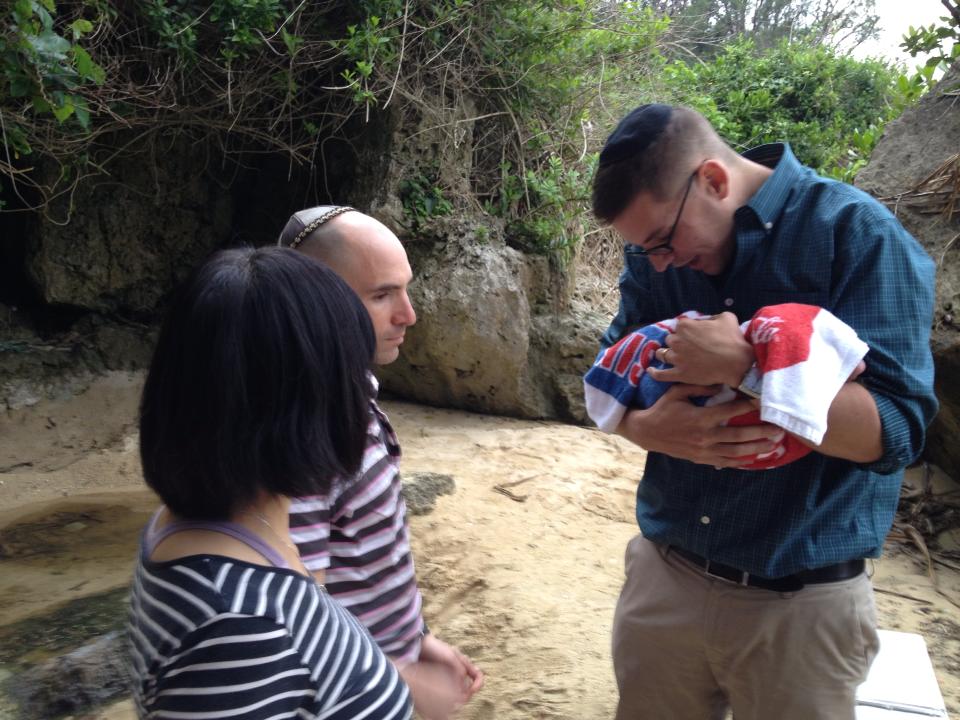
I tell you this not to give you laws of mikvah, but to share a story from my week.  Having returned mid-week from Yokota Air Base in Tokyo, I was asked (prior to my expected flight out to Guam) to make a baby girl (whose father is Jewish and whose mother is in process of converting) into a Jewish baby girl.

I love simchas and I was more than delighted to put together a little ceremony for them (we are also going to have a simchat bat in synagogue in a few weeks).  Originally, I was going to have us all wade into the East China Sea – as we did for the  adult conversions this past Spring.  But then, Betty Hoffman had a brilliant suggestion.

Just below her house (which is on a beautiful cliff and the beach that we were going to use) is a natural spring.  At one point considered a sacred spring (like most springs in Okinawa), it is set into the cliffs and surrounded by a series of caves.  The water in the spring is beautiful, clear and fresh; it pools at about one foot of depth and then flows down into the ocean 10 yards away.  “Can we use the spring?”  Not only can we use the spring, but it is an ideal Mikvah.  While not quite big enough for an adult, we immersed Chloe Ayumi Beyer (Esther Chanah bat Avraham) in the Ancient Okinawan Mikvah.  
The walk down to the Mikvah.  The New Abba is carrying the New Baby.
The New Grandma is walking the Grand-Puppy.

We gave her some wine - because everybody is entitled to some wine at Jewish rituals.
I sang HaMalakh HaGoel as I explained to Chloe how luck of a girl she was and all that she was about to experience.
There is no reason for me to be the only one getting wet.  Bath time is fun for rabbis, abbas and babies.
We rolled up our pants as we walked into the Spring.


"And now you have a whole new Jewish name!  Esther Hannah - a pretty good name for a girl born on Purim".  Esther's Abba, Ema and Rabbi give her a blessing.