Friday, October 26, 2012

What A Way to Start the Day


“Chaps, enjoying your motivated nature walk?!”

Mile Six of a nine mile march through the Central Training Area on Camp Hansen.  We’re marching along in heavy boots, sweating through our uniforms, and carrying packs that weigh as much as some of the smaller Marines.

All you can do is smile, grunt, and trudge forward, because if you look around you will see it is – in fact – “freakin beautiful” out there (I was told today that the word “beautiful” does not translate to Marines without the qualifier “freakin” or its more explicit lexical cousin). 

We set out on the hump at 0530 (hump is the noun that refers to hiking with large quantities of gear strapped to one’s back).  Orion was looking down on me (I know this because its one of the few constellations that I can identify).

One mile. Too easy.  What are the Marines always complaining about?

Two miles.  The bottoms of my feet hurt.  Insert another expletive.  This is going to be a long trip.

Three miles.  A discussion of Ferris Bueller’s Day Off – referred to by one officer as “Ferris Bueller’s Big Day” - ensues amongst the officers in the rear.  This officer is hit in the head by another officer.  General consensus: good movie, though the contempt for elders and those in authoritative positions is not condoned by this Corps.

Four miles.  The sun is coming up.  The birds are chirping.  We enter the CTA, and we look out on the rolling hills that lead toward the mountain.  The ocean sparkles in the background.  It is freakin beautiful.

Five miles.  “Can I ask you a question, and I don’t mean it to be racist or anything like that?”  “Sure, any question is a good question.”  “Why does it seem that Jewish people always vote Democrat.”  Uh oh. 

Six miles.  Curse those freakin rolling hills.  I miss flat land.  My freakin feet are freakin killing me.  The freakin nerves in my freakin shoulders are freakin being pinched.  We have freakin 7 ton trucks, MRAPs, and Humvees.  We’ve got helicopters, planes, and whatever you want to call the Osprey.  Landing craft and amphibious vehicles.  What are we freakin doing humping this far?!

Seven miles.  “Sure the blue jolly rancher will make your mouth turn blue, but the watermelon jolly rancher is by far the best.”  Gunny is saying something wildly inappropriate that he heard on Rush. 

Eight miles.   I see the end!  I see the end!  Why are we not turning?

Nine miles.  What a beautiful way to start the day.

They called it a “conditioning hike”.  We are working our way up to a 15 mile hike in the not-so-distant future.  Our company commander asked the Marines why we did such a thing?  Why not just take the 7 ton truck, or the Humvee, or a Honcho (taxi).
He gave the usual Marine Corps answers: It builds endurance.  It motivates us as a team.  The Marine Corps heritage is built on humping it from place to place.
But if I were giving an answer: to be motivated by nature.  Have a freakin beautiful Navy/Marine Corps Day.

Friday, October 19, 2012

looking back


Yoni’s father, Jay Warren, served two tours as a Marine during the war in Vietnam. During that time, Okinawa (then a relatively new acquisition for the Americans) was used as a staging ground and training area for troops headed into battle. As such, Jay spent several months on Okinawa during (I believe) 1968-69 and 1972-73.

Before their trip out here, I spent some time thinking about the kinds of things Jay and Tova might like to do (much like I did for my parents). I knew there would be museums, and shopping, and probably a trip to the aquarium. But I don’t think I really understood how much time Jay had spent here, and so I didn’t factor touring his old stomping-grounds into my plans. Luckily, Jay spoke up, plans were revised, and we spent an afternoon visiting Camps Schwab and Hansen.

Those of you who pay very close attention and have excellent memories might know that Yoni’s office is on Camp Hansen, which is a 45-60 minute drive from our apartment on Camp Foster. Camp Schwab is an additional 35 minutes north past Hansen. All of which is to say – there wasn’t too much for Jay to remember in our neighborhood (although, according to Yoni, apparently one light switch outside the Jewish Chapel had really stuck in his memory). This is especially true considering the fact that Jay and other young Marines were not allowed to have cars, as well as the fact that, in those days, there was no inter-camp bus system. But the further north we got, the more Jay remembered. Most of the businesses had changed, but apparently some of the structures are the same.

Once we got onto Schwab, things became a lot more familiar for Jay. He was able to direct me to the area of the Camp where his barracks had been, and the buildings were still standing – repurposed, but standing nonetheless. He pointed out a beach where they did “rubber boat training,” a building that was used as the Mess Hall, and even where he thought the Exchange had been (a tiny room compared to today’s). The same was true when we arrived at Hansen.

There was something incredibly poignant and cool about seeing Schwab and Hansen through Jay’s eyes. I know that American troops are stationed in Okinawa because of our history with this island, but while it’s easy to remember that history when you’re at a museum, it can be hard (at least for me) to remember it when you’re shopping at the Exchange or eating at Subway.  Seeing the island through Jay’s eyes, even just for a few hours, helped me to remember that we are not the first people to be stuck out here in the middle of the Pacific Ocean. And while Okinawa is no longer a jumping off point for Marines headed to Vietnam, it is a home base for many members of the military deployed to Afghanistan. The bars change owners, the barracks get rebuilt, the island gets developed – but some things don’t change. I hope that, at some point in the not-so-distant future, there will be a time when Okinawa is not a staging ground for any war. In the meantime, we’ll be here, carrying the torch.  

Friday, October 12, 2012

we're on vacation

Yoni and I, along with Jay and Tova, are off island for the weekend. We escaped to Ie island, a small island off the northern coast of Okinawa. As such, there will be no formal blog post...instead, I'm including this picture of the view from our balcony. We'll be back next week, I promise!

Friday, October 5, 2012

The Osprey


It seems that the Japanese people are not excited about the arrival of the MV-22 (Osprey).  To be fair, some really don’t care.  But overall, the Japanese – inclusive of the Okinawans – do not want the Osprey.

The Osprey is one of the newest additions to the Air Combat Element.  It is a hybrid helicopter/fixed-wing plane.  It takes off vertically, and then converts to take material over a larger distance in faster time than the standard helicopter.  More importantly, it will replace the CH-46 Sea Knights that have been in Okinawa for over 40 years now.

I’m not writing in defense of Marine Corps aviation or the Osprey.  There are much more eloquent voices on the subject. I do not have a comment on safety or protocols for these planes.  But I would really like to take a flight in one.


What is truly impressive is the protest.  Last week, prior to the start of the typhoon, it was reported that some 20,000 had taken to the streets to block the entrances of Futenma Marine Corps Air Station.


It should be noted that the Ospreys were coming from mainland Japan, and had no intention of driving through the gates of Futenma.  But I get the symbolic gesture.
I have a friend – another chaplain – who got locked onto the base for days simply because of the protests that continued again after the typhoon.  For awhile, my car was locked on base and I couldn’t find out if it was wrecked in the typhoon.  (Don’t worry, the Marshmellow is OK – but not every car faired well.)

Big signs line the park at the entrance of Futenma declaring: “We don’t need no MV-22s” and “Osprey not safe”.  Vans painted blue with bright yellow lettering reinforce the message; “Keep Osprey out of Oki”.

Chants are shouted in English and Japanese.  I drove behind a van with a loud speaker attached to the roof, as it declared that the Osprey would kill children… and that is what was said in English.  I’m not sure the Japanese version was as calm.
Marines, in the meantime, are more or less on lockdown and are told to be on their best behavior in town.  Any spark could soil relations with Japan for a very long time.
We are not allowed to walk, bike, skateboard or roller blade past “International Friendship Park” (the square in front of Futenma). 
Roll up your windows.  Lock your doors.
Turn on your flashers.
Follow the directions of the Okinawan police.
Then follow the directions of the first line of Base guards.
Then follow the direction of the gate guards.
Please don’t hit anybody.

The protests are now entering their second week.  Many of the protesters are sponsored by organization and have no end in sight.  I hope that this is just something that will take time, but that we will be able to move forward.

Friday, September 28, 2012

jane wayne


I am not cut out to be a Marine.

I don’t want you to get the wrong idea – I never considered becoming a Marine, nor did I ever labor under the misapprehension that I would be qualified or well suited for such a choice. Nevertheless, even though I am and have always been quite secure in my decision not to pursue a career in the armed forces, last Friday I had the chance to find out, once and for all, whether or not I was right. And it turns out I know myself pretty well.

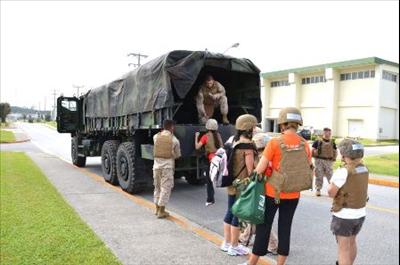
Of what do I speak? Well, last Friday, I participated in a long-time Marine Corps tradition called Jane Wayne Day. I honestly don’t know where they came up with the name, but the idea of Jane Wayne day is to let spouses (most often wives) get a taste of some of the things their husbands do on a regular basis. I asked if we would be doing marriage counseling, leading services, and visiting people in the brig – but no, that wasn’t what they had in store for us. Instead, we ran a modified CFT (combat fitness test), had a lesson in MCMAP (Marine Corps Martial Arts Program), ate MREs (meals ready to eat – what Marines eat in the field) for lunch, conquered the obstacle course, and went in a convoy simulator. Oh, and we rode around in big trucks, stood in formations, and got yelled at by drill sergeants. 

As to whether or not a typical Marine would do all those things in one day, I have no idea. But, as ridiculous as the idea of Jane Wayne day sounds, I do think it provides some much needed perspective to many spouses on the kinds of things their spouses are expected to do at work on a daily basis. Even the waiver we had to sign to participate was instructive; we were warned that we might sustain physical and emotional damage, and had to agree that neither we nor our offspring nor our next of kin nor our debtors nor our executors nor our friends-who-used-to-be-our-neighbors-down-the-block could sue the Marine Corps if something DID happen. I had fun doing it for one day, but like I said, I am more sure than ever that I could never ever do that every day.

I didn’t take any pictures of my own, but here are a few of our group that were distributed. Shabbat Shalom! 


Friday, September 21, 2012

Stop and Look Around


Leora is supposed to write this week, but I’m going to give her a week off.

I’m writing this on a Thursday evening – Japan time.  I’m sitting in a little bit of a snooty outdoor café overlooking a beautiful stream.  The waiters are stacking oranges in the displays out front, but I’m now under the impression that they are for show and not for eating.

I’m sipping away at a Hoegaarden White.  As expected, it is just as good in mainland Japan as it is in the States.  One can never be too sure, so I might have to order another.

Across the river there is a beautiful green park full of exactly the trees that you would expect to see in a beautiful green park, all manicured to perfection.  I would expect nothing less from Japan.

There is music nearby emanating from the park.  There are definitely little cymbals and a string instrument.  I would say there is a piano, but that seems unlikely.

Behind me, the streets are bustling.  I almost makes me think of Central Park.  How it almost seems weird that there is a real city just outside the confines of the park.  The park has a life of its own.

A Japanese baseball team just ran in front of me, laughing and having a good time.  Purple uniforms with electric green writing was not a good decision.  They should get some Oriole’s Magic.  Orange and Black.

The snooty waiters are now giving me a look for being on my computer in their snooty café.  I order another beer and they seem to mind a little less.  I’m a sailor, buddy.  If it comes down to it, I can do this all night.  Bring an orange with the next beer.

Another beer.  No orange.

I know my drinking a beer is hardly newsworthy, but I’m drinking a beer in Hiroshima.  I’m sitting maybe 50 feet from the epicenter of the blast that killed hundreds of thousands of souls some 70 years ago.

Considering that seventy years ago, there was literally nothing in the city, Hiroshima is now a sprawling metropolis.

I remember how I first felt when I sat down in Oswiezem, the Polish town located just outside of the gates of the Auschwitz Death Camp.  How can a person live here?  How can you make your daily life on the very ground where so many perished?

They said in the museum that following the blast, the people were told that nothing green will grow in Hiroshima for at least 75 years.  They defied the odds.  First, there was one tree.  One side burnt by radiation, the other side pushed forth with leaves and seeds.

I still don’t know the answer to my questions, but I am amazed, impressed, and inspired by the resilient people of Hiroshima.  They replanted, rebuilt, and rededicated themselves.  Hiroshima was once a military town; Hiroshima is now a town dedicated to peace and nuclear non-proliferation.

I’m currently on my rabbinical whirlwind tour of the area.  I spent Rosh Hashana in Okinawa, and put together a nice holiday for my regular group.  Today, I visited Iwakuni again (and since there are very few Jews at Marine Corps Air Station Iwakuni), I had a little time to wander up to Hiroshima.  In the next few days, I’m headed to Sasebo (in the Nakasaki Prefecture) and to Guam. 

I imagine that few of my friends and family will have the opportunity to see this town, and as soon as I can get my camera to upload pictures I will attach them to this post.